
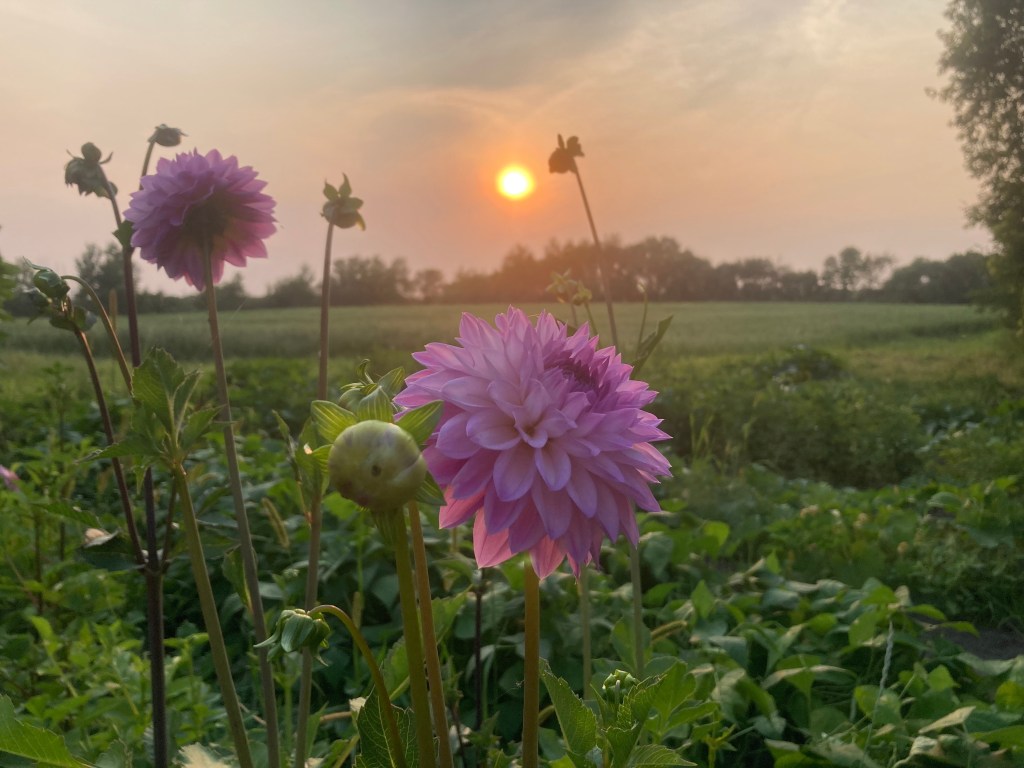
Continuing my passion for cut flowers, I decided to give dahlia breeding a try this last summer! The image above is a new variety discovered in my garden from “Bee’s Choice” seeds purchased from Floret. This coming summer will be year two with this beauty and as long as she continues to impress she will become a permanent member of my tuber collection (and I get to name her)! While I am no expert at it, I wanted to share some of the basics of dahlia breeding and discovering new varieties with you in case you wanted to give it a try! Dahlias can be grown from tubers, rooted cuttings, or seeds. Tubers and rooted cuttings will yield an identical plant to the parent, but seeds will create a completely new variety!
Tubers
Tubers are the roots of the dahlia and can somewhat resemble a potato. Tubers can be divided and used to grow an exact replica of the parent plant. This is because the tuber multiplies producing genetically identical “baby” tubers. Tubers can come in many shapes and sizes, and the size of the tuber does not affect the size of the plant. Growing conditions and other factors, however, can affect the size of the plant just like any other flowers you may grow! If you are looking to grow a specific, predictable type of dahlia, tubers are a great option! The vary greatly in price but can be stored and replanted year after year. They also multiply so they can be divided each year to grow your stock!

Rooted Cuttings
Rooted cuttings are another way to grow an identical plant to the parent. Many businesses sell these as well! Make sure if you choose to obtain your dahlias this way you find a reputable seller and ensure they have been disease tested. I have personally never grown dahlias from cuttings, but I have grown many other plants from cuttings and it seems to work well! You can also take cuttings from your own tubers to root and grow, multiplying your stock! Tubers can also be saved from the rooted cuttings at the end of the season and be stored and planted again!
Seeds
Seeds from a specific dahlia will not yield a genetically identical plant to the parent. While tubers and cuttings are taken from one parent plant with only one genetic makeup, seeds are generally formed from two parent plants with genetically different makeups. I say generally because there can be instances of self pollination, but if you leave it up to the bees you will likely have two parent plants. Because of this, seeds will grow a completely different and new variety of dahlia, hence breeding! Collecting and saving seeds from your dahlias in the fall and then replanting them in the spring will result in completely new dahlias! How cool is that?! If you find one that you love, you can dig up and save the tubers to plant the same dahlia again the following year which is how all varieties started! Just be sure to mark it somehow in the field so that when it comes time to dig up the tubers you are able to identify which ones to dig as most will not likely be keepers. If you discover a new variety, you also get to name it which is pretty dang awesome if you ask me!
There are ways to control the two parents of the seeds, but I prefer to leave it up to the bees! Organza bags can be placed over flower heads to prevent insects from pollinating the flower and tools like a paint brush can be used to collect pollen from one flower to be transferred to another. There are wonderful resources available if you are interested in doing this. At this time, I don’t have enough experience to give advice on this method. The bees take care of that for me.

Well…. are you convinced? Are you going to give dahlia breeding a try this year? Or maybe you are considering starting your collection of dahlias in the form of tubers or rooted cuttings instead which is awesome! In most areas, at least in the United States, tubers will need to be dug up each fall and properly stored each winter so they don’t freeze. However, they are stunning flowers and finding a new variety that you love is absolutely magical! You can make the process as complicated or simple as you want. I prefer simplicity haha! Happy gardening!

 Life on Lady Slipper Lane
One response to “Beginner’s Guide to the Basics of Dahlia Breeding”
[…] this year, I shared a beginner’s guide to the basics of dahlia breeding. I am really hoping that some of you have either decided to give this a try, are already dahlia […]
LikeLike